When a leading philanthropic funder reached the limits of project-based grantmaking, the question was no longer how much capital to deploy, but how to redesign the decisions the capital was funding.
Case study9 min read
The IKEA Foundation reached a question by 2020 that capital alone could not answer. After years of funding agricultural livelihoods programs across South Asia and East Africa, the team running the portfolio could see the outputs of every grant on a dashboard. What they could not see, with the precision they wanted, was whether the system around those grants was shifting, or whether the portfolio was holding back a tide that would resume the moment the funding paused.
The grantmaker's blind spot
Conventional philanthropy operates on a project logic. A grant is made, deliverables are agreed, outputs are measured, and the cycle closes. This logic suits discrete interventions: build a school, vaccinate a population, distribute seed stock. It does not suit anything where the desired outcome depends on the behavior of a system the funder does not control.
Agricultural livelihoods sit firmly in the second category. A smallholder farmer in Kenya does not improve her income because she received better seeds. She improves it because seeds, credit, water access, market routes, soil knowledge, weather data, household labor allocation, and the price set by a buyer she has never met all aligned in her favor for a season. A grant that touches one of those variables can shift outcomes for a year. A change in the system that produces those variables can shift outcomes for a generation.
The IKEA Foundation understood this. What it lacked was a working method for funding the second kind of change without losing the operational discipline that any large funder requires.
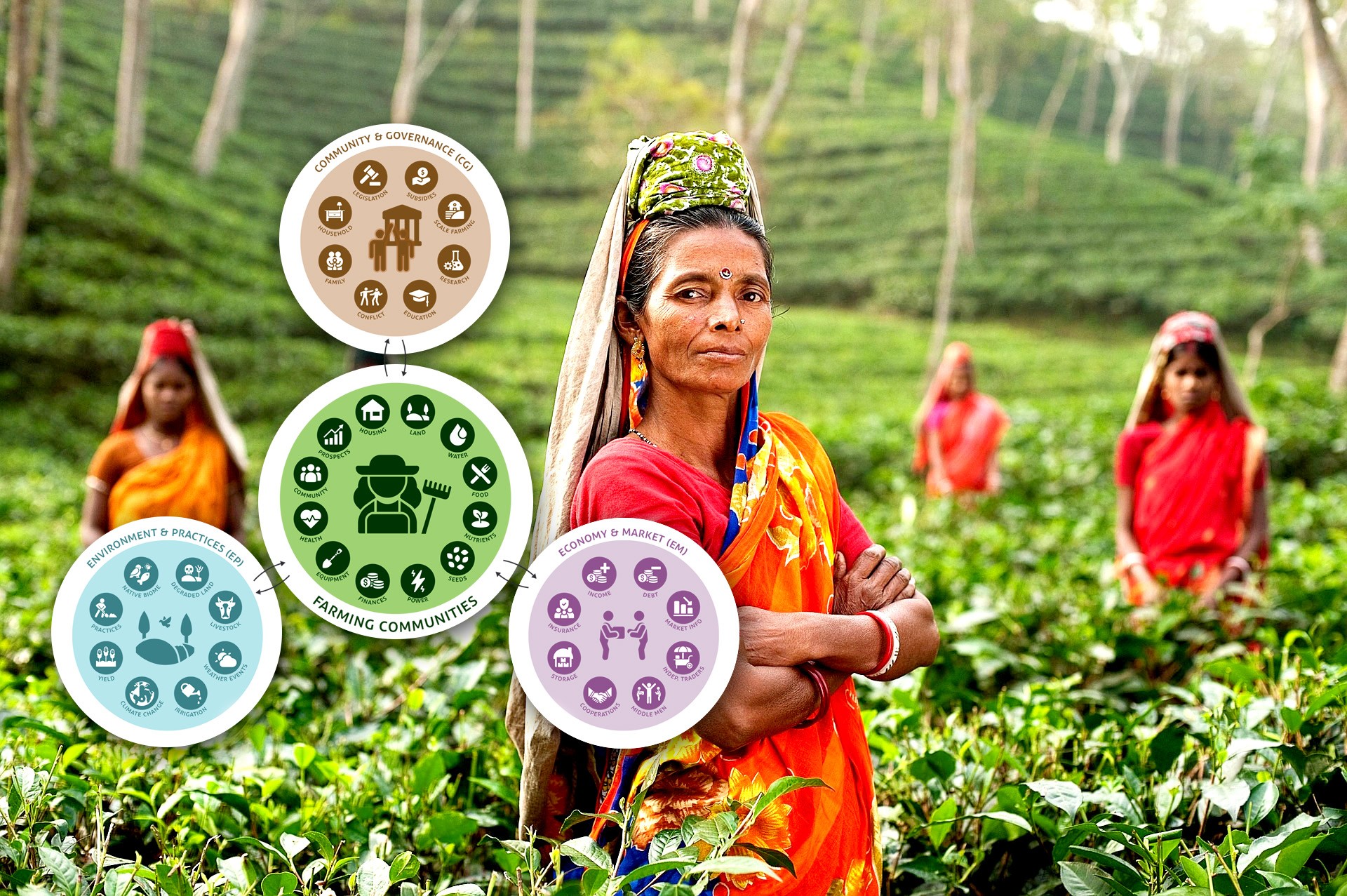
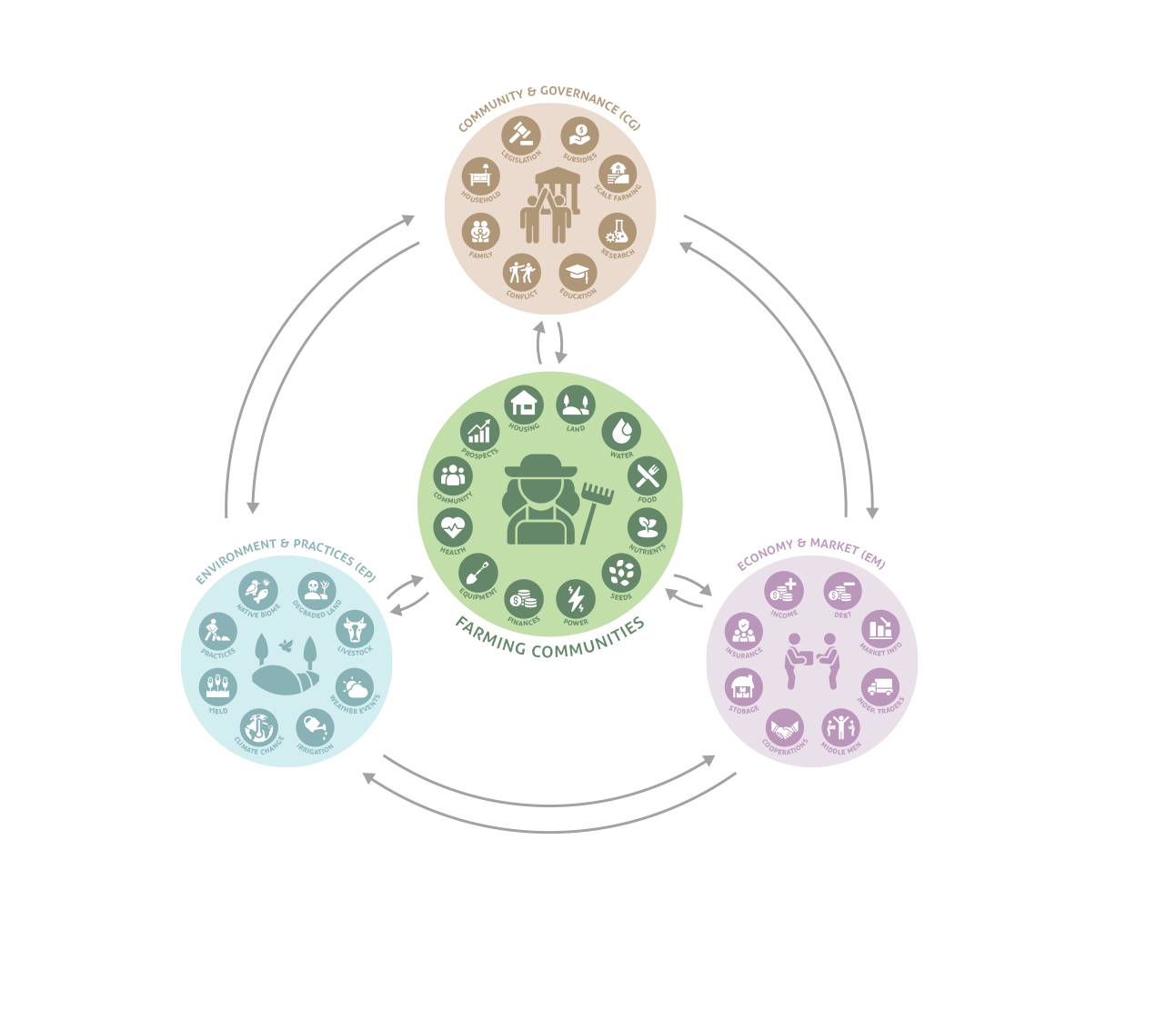
The farmer-level system map developed for the Kenya portfolio: an individual smallholder at the center, with every actor, flow, and dependency that shapes her economic position organized across four interdependent layers.
What the brief actually asked for
Yvoke, the strategy practice of Except Integrated Sustainability, was engaged to develop a framework that would let the foundation's grantmaking team move from project-based decisions to systemic ones. The brief was not a slogan exercise. It asked for tools the team could use on a Tuesday morning, when a partner organization submitted a proposal and a decision was needed by the end of the week.
The project ran on Symbiosis in Development, the systemic strategy framework Except has applied since 1999 across more than 600 projects in industry, government, and civil society. SiD treats any intervention as an action within a system, and any system as the interaction of four interdependent layers: ecology, social fabric, economy, and infrastructure. A grant decision evaluated through SiD is not a yes or no on a project. It is a question about which layer the intervention enters, which reinforcing or balancing loops it activates, and what the system is likely to do in response.
The reframing matters because it changes the question the program officer is paid to answer. Conventional grantmaking asks: will this project deliver its outputs. Systemic grantmaking asks: will this project, combined with the foundation's other commitments and the partner ecosystem already in motion, shift the conditions that produce the outcomes the foundation cares about. Different question, different evidence, different portfolio.
“
A project is the smallest unit of philanthropic accounting. A system is the smallest unit of philanthropic effect. The work was building a bridge between the two.
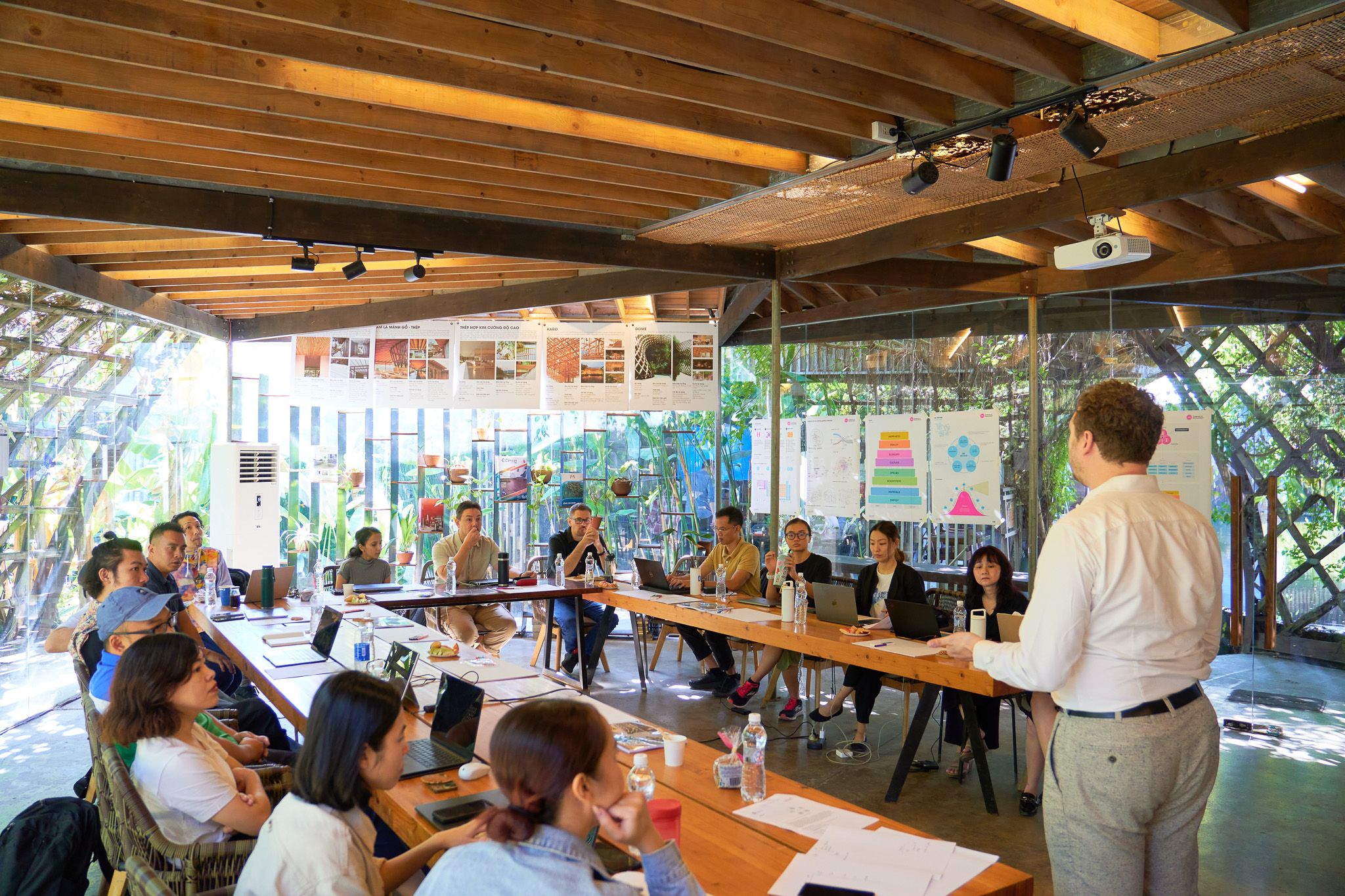
Co-creation with foundation staff: design work rather than training, with the people who would use the framework given standing to revise it.
Building from the field outward
The first concrete output of the engagement was a farmer-level system diagram drawn from field data the foundation's program partners had already collected in Kenya. The diagram placed an individual smallholder at the center, with every actor, flow, and dependency that determined her economic position arranged around her, organized by the four SiD layers and by the time horizons across which each operated.
The diagram was not a deliverable in the usual sense. It was a working surface. Program officers used it to test new partner proposals by asking which nodes the partner would touch, which loops would be activated, and where the foundation's existing portfolio already pressed on the same system. Within months, the same diagrammatic logic was being applied to portfolios beyond Kenya.
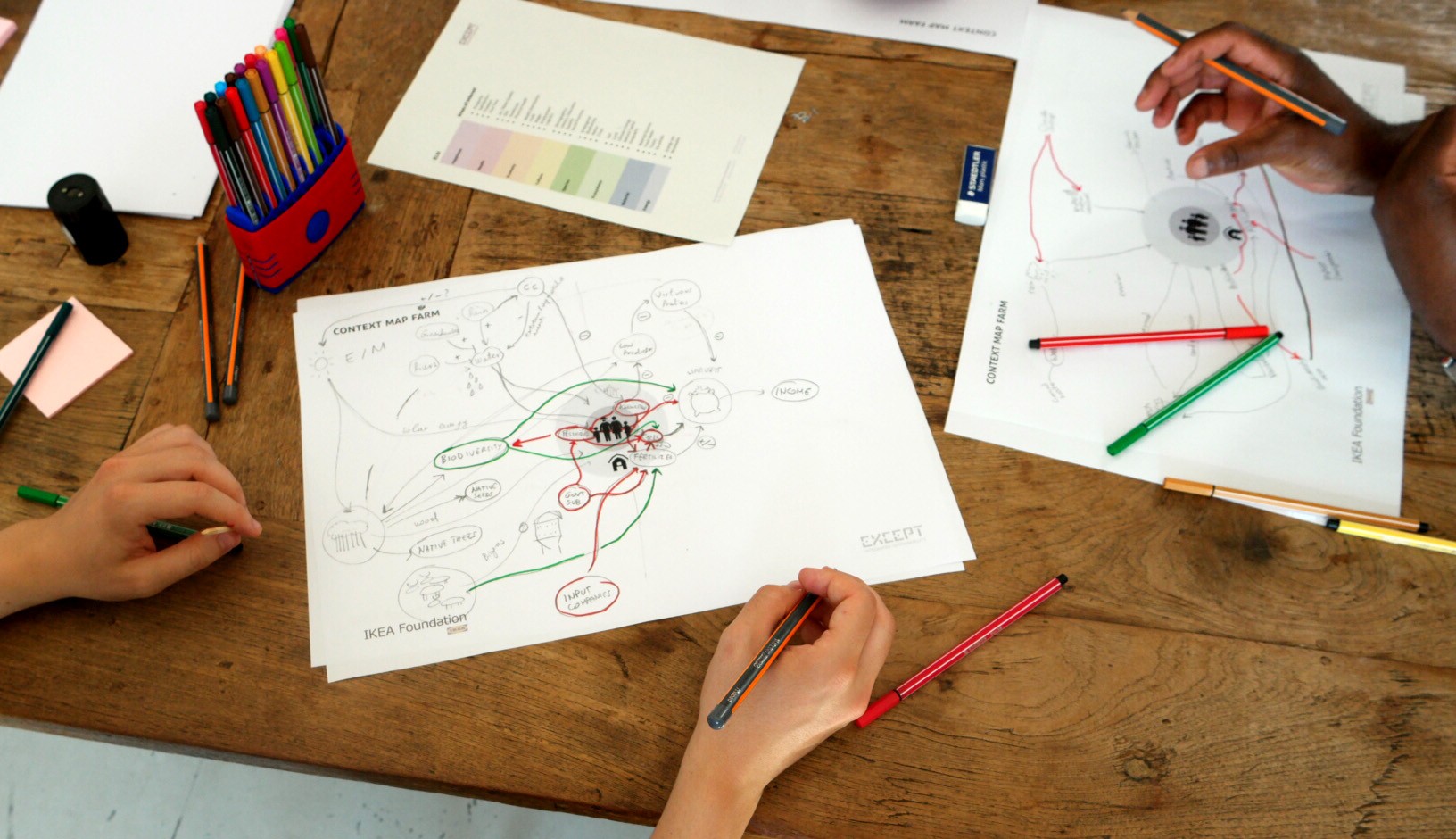
Strategy frameworks designed in isolation tend to fail on contact with operations. The Yvoke team ran a sequence of co-creation workshops with foundation staff across geographies, building the framework iteratively against the team's actual decision moments. The workshops were not training sessions. They were design sessions in which the people who would use the framework had standing to revise it.
The strategy summary: a framework calibrated to read in either direction, bottom-up from the field or top-down from thematic priorities.
The field context: smallholder agriculture is the boundary case where systemic and conventional grantmaking diverge most visibly.
A framework that reads in two directions
The result was a strategic framework designed to work either way. A program officer in the field could apply it bottom-up, starting from a local intervention and tracing the system effects outward. A portfolio director at the foundation could apply it top-down, starting from a thematic priority and identifying the entry points where the foundation could plausibly act. The same diagrams, read in either direction, produced compatible decisions.
This dual-direction property is unusual in strategy work. Most frameworks privilege one orientation, which is why field teams and headquarters often appear to be running different programs under the same budget line. Designing for compatibility across that gap was the engagement's quiet structural achievement, and the one that most directly affected how the foundation's team operates inside its own portfolio reviews.
The engagement
1999year the SiD framework was first developed and deployed
600+projects worldwide applying SiD across sectors and scales
4categories of strategic deliverable produced for the foundation
2directions the framework runs in: bottom-up and top-down
What changed
By the end of the engagement, the foundation had four operating tools: a strategic framework adaptable to top-down and bottom-up application; farmer-level system diagrams calibrated to the agricultural livelihoods portfolio; a set of mapping tools that allowed program staff to extend the analysis to new geographies; and a communication suite that allowed internal teams and external partners to align on a shared system view.
What the engagement did not produce was a single headline metric of impact. The work was upstream of that. It changed the lens through which the foundation's grantmakers saw their portfolio, which in turn changed which proposals were funded, which partnerships were extended, and which interventions were retired. The downstream effects on farmer incomes, soil health, and rural economies belong to the partners and the farmers, not to the consultancy. That distinction matters. Claiming credit for outcomes that depend on hundreds of independent actors is the kind of attribution error that has discredited a generation of impact reporting.
“
By growing their understanding of systems thinking and its tools, and using these to identify themes and enhance partnerships, the foundation is well-positioned as an emergent market leader.
The replication question
Systemic grantmaking is an emerging discipline. The IKEA Foundation is among a small number of large funders applying systems-thinking methods to portfolio design rather than only to communications. The gap between conventional and systemic grantmaking is operational, not philosophical. It shows up in how partner proposals are scored, how progress is tracked, and how a portfolio director decides what to fund next.
For boards and executive teams in foundations and corporate philanthropy, the practical questions are these: where in the grantmaking cycle does systemic analysis enter, who has authority to apply it, and what does the foundation do when the analysis points toward a partner the foundation has not historically worked with. The engagement did not resolve those questions in the abstract. It made them visible enough to be answered, case by case, inside the foundation's existing operating rhythm.
The broader implication for any organization that deploys capital toward systemic change, whether through grants, investments, or its own balance sheet, is that the tools used to make decisions determine the kind of change it is possible to fund. Conventional procurement, conventional grantmaking, and conventional investment all share an assumption that the project is the unit of analysis. Systemic work begins where that assumption ends, and the cost of crossing the threshold is mostly the cost of redesigning the internal decision moments that already exist, rather than building anything new from scratch.
That sequence applies across sectors. The parameters change. The logic does not.