Can the Netherlands be CO2-neutral by 2040?
The Dutch ministry asked what projects are needed to make the Netherlands CO2-neutral by 2040. The answer was not a list of projects. It was a data system.
Key result
A single systemic insight: open-source national data infrastructure is the prerequisite for decarbonization
The brief from the Dutch Ministry was direct: what projects would make the Netherlands CO2-neutral by 2040? The expected output was a list. A portfolio of infrastructure investments, policy changes, and technology deployments that, taken together, would decarbonize the Dutch economy. That is a reasonable expectation. It is also the wrong question, and recognizing why it is the wrong question turned out to be the most important finding of the project.
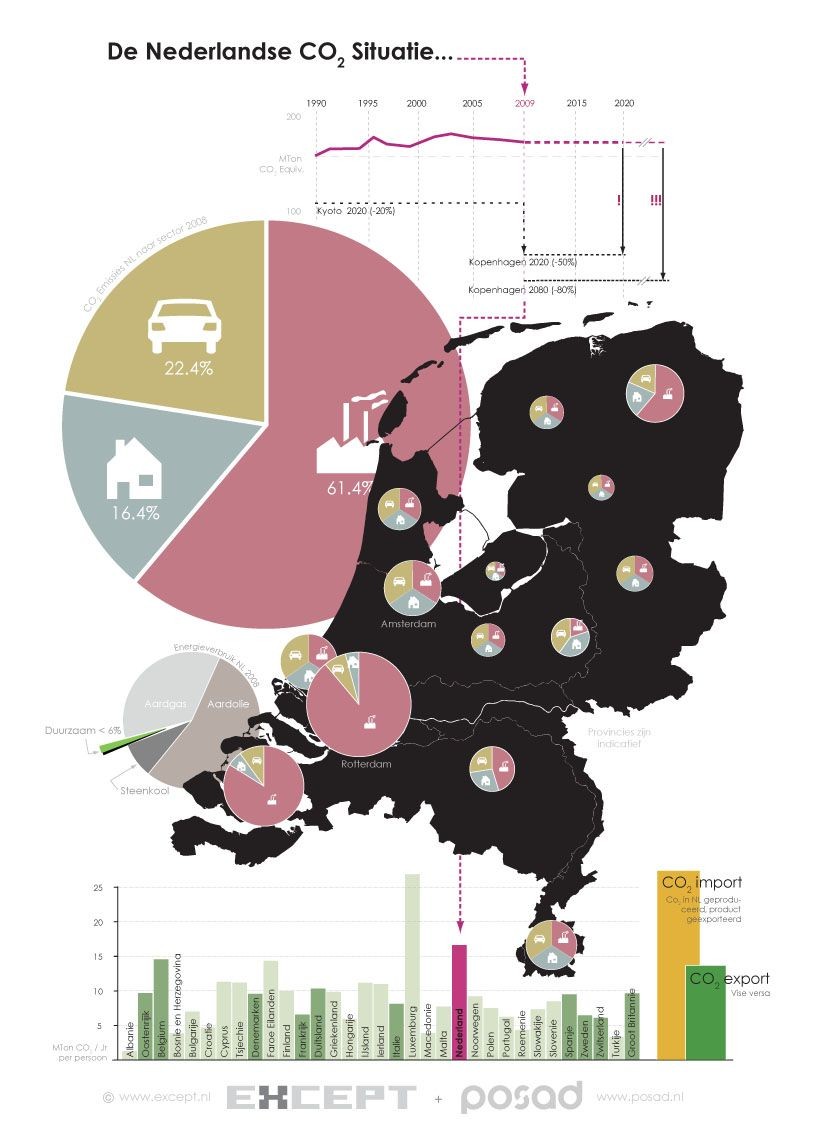
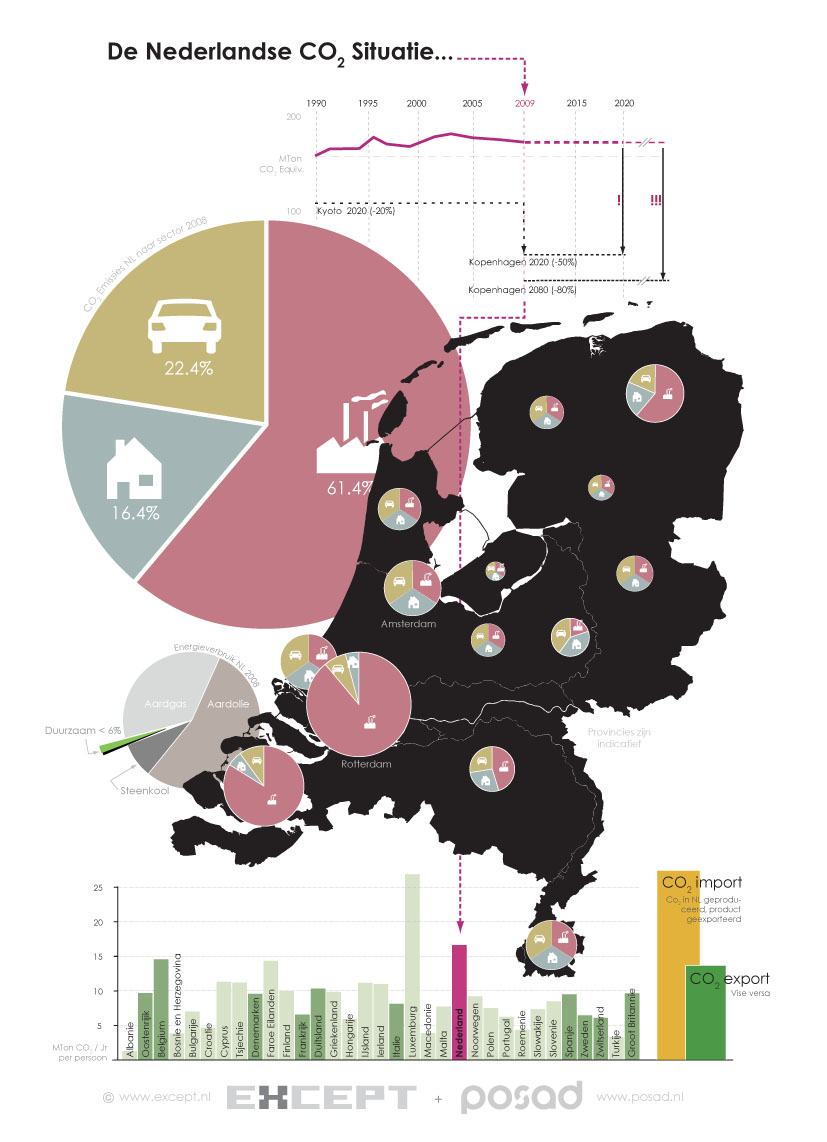
Except and Posad Spatial Strategies approached the brief by applying network analysis and systems mapping to the Dutch economy's carbon flows. The analysis traced CO2 emissions through their full causal chains: from the built environment, transportation, industry, production chains, and development patterns that generate them, through the governance and market structures that regulate them, to the information systems that make them visible or invisible to decision-makers.
The information bottleneck
The analysis produced a finding that surprised even the project team. The single largest barrier to decarbonization in the Netherlands was not technical, financial, or political. It was informational. The data needed to identify, plan, and execute carbon reduction projects existed in dozens of disconnected databases, each owned by different agencies, formatted in different ways, and accessible to different audiences. No actor in the system, not the national government, not municipalities, not businesses, not citizens, could see the full picture of where carbon flows originated, how they connected to other flows, and where intervention would produce the greatest reduction.
This information fragmentation does not just slow down decarbonization. It makes certain categories of solution invisible. The highest-value carbon reduction opportunities in a dense, interconnected economy like the Netherlands are typically cross-sectoral: industrial waste heat warming residential buildings, logistics optimization across supply chains, coordinated renovation programs that achieve district-scale energy performance rather than building-by-building improvements. These opportunities exist at the interfaces between systems that are currently managed by different organizations using different data. Without a shared information layer, they cannot be seen, and what cannot be seen cannot be acted on.
Five example interventions
To illustrate what becomes possible with transparent data infrastructure, the project developed five concrete intervention examples spanning different scales and sectors.
At national scale: a strategic renovation program for the existing building stock, guided by GIS-based analysis of energy performance, construction type, and neighborhood characteristics. Instead of offering generic retrofit incentives, the program would target specific building clusters where coordinated renovation produces district-level energy performance improvements at lower cost per unit than individual building upgrades.
At regional scale: coupling industrial waste energy flows with residential heating demand, using spatial data to identify where producers and consumers of thermal energy are close enough for infrastructure connections to be economically viable.
At neighborhood scale: integrated development of mixed-use districts that combine renewable energy generation, material flow management, and mobility infrastructure into a single system rather than treating each as a separate planning domain.
At individual scale: tools that allow citizens and businesses to see their own carbon footprint in the context of their neighborhood, their city, and their region, with actionable information about what changes would produce the largest reduction.
The leverage point
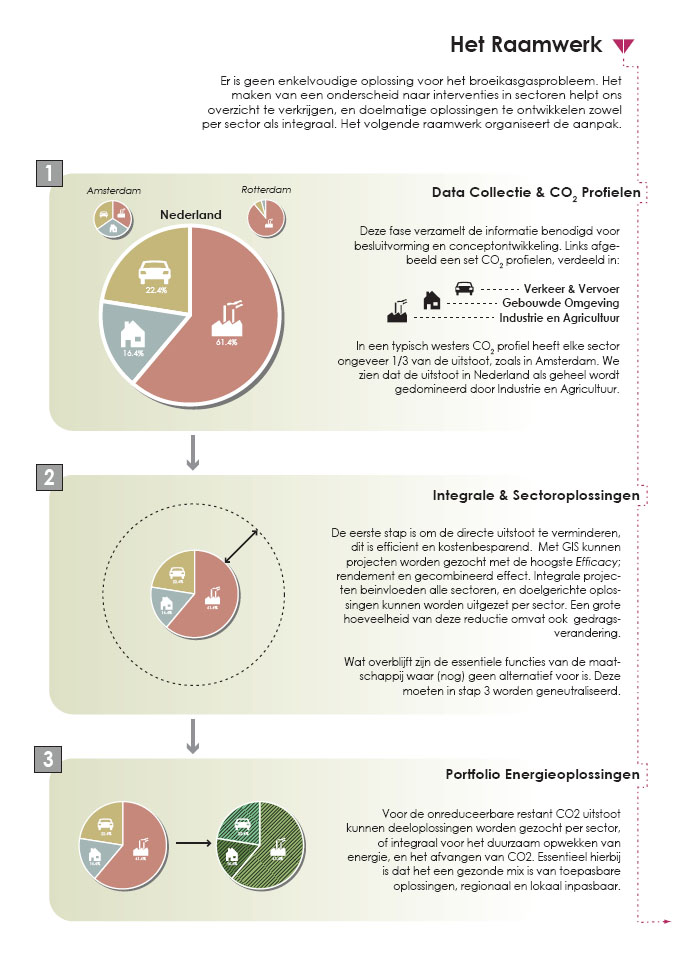
The project's central finding was that an overarching, national data system, fully transparent, fully open-source, and usable by all actors in society, is the prerequisite for achieving CO2 neutrality. Without it, the connections needed between transportation, the built environment, industry, and development cannot be made visible, and concrete action plans cannot be developed to address the highest-impact opportunities first.
This is a leverage point in the Donella Meadows sense: a place in the system where a relatively modest intervention, building a data infrastructure, changes the behavior of the entire system, because it changes what every actor can see and therefore what every actor can do. The technology required is not novel. GIS, LCA databases, and visualization platforms all exist. The barrier is institutional: getting dozens of agencies, ministries, and data owners to agree on standards, access protocols, and governance.
The ministry received the report well. It reinforced a growing recognition that data transparency and registration processes are prerequisites for environmental performance at national scale. The research contributed to awareness of how information architecture shapes a country's ability to act on climate commitments, and how its impacts extend across economic, environmental, and social outcomes simultaneously.
The insight from CO2040 applies beyond the Netherlands. Any country or city attempting systemic decarbonization faces the same structural challenge: the carbon reduction opportunities with the highest returns are cross-sectoral, and cross-sectoral opportunities require shared information infrastructure. Building that infrastructure is not a technical project. It is a governance design problem. And it is the single highest-leverage intervention available.
The CO2040 project changed how the team thinks about the relationship between information and action. In conventional policy, you identify the problem, design the solution, then build the information systems to monitor implementation. CO2040 reversed the sequence. It showed that building the information system is the solution, because without it, the problems and their solutions remain invisible to the actors who need to act. That reversal, putting the data layer first, is the project's most transferable insight. Every jurisdiction attempting decarbonization at scale will eventually arrive at the same conclusion. CO2040 arrived there first.
More case studies



Ready to map your system?
Every case begins with a conversation about the system you operate in and the leverage points within it.
Book an introduction