Pizza 4P's: 15-year strategy
Comprehensive sustainability strategy using SiD framework. Leadership training, co-creation workshop in Ho Chi Minh City. 15-year roadmap across energy, water, biodiversity, and community.
Key result
15-year roadmap across energy, water, biodiversity, and community
Pizza 4P's began as a single restaurant in Ho Chi Minh City in 2011, founded by Japanese entrepreneur Yosuke Masuko with an idea that sounded deceptively simple: make pizza with cheese produced on-site, using ingredients sourced from local farms. Fourteen years later, the chain operates dozens of restaurants across Vietnam, grows vegetables in its own farms, makes mozzarella in its own dairy, and has become one of Southeast Asia's most recognized food brands. Its "Deliver Wow, Share Happiness" philosophy is more than a slogan. It shapes menus, supplier relationships, restaurant design, and community engagement.
But as the company grew, so did the complexity of its impacts. Energy consumption across restaurants, farms, and production facilities. Water use in cheese-making and agriculture. Biodiversity effects of sourcing decisions. Waste streams from kitchens and packaging. Community relationships that had been personal when the company was small but needed structure at scale. Pizza 4P's leadership understood that treating each of these issues separately would produce a patchwork of initiatives competing for attention and budget. They needed a way to see the whole system and design a strategy that addressed it as one.
That is where Except's engagement began: not with a list of quick wins, but with the question of how a fast-growing restaurant company can embed sustainability into its operating logic for the next 15 years.
Seeing the system before designing the strategy
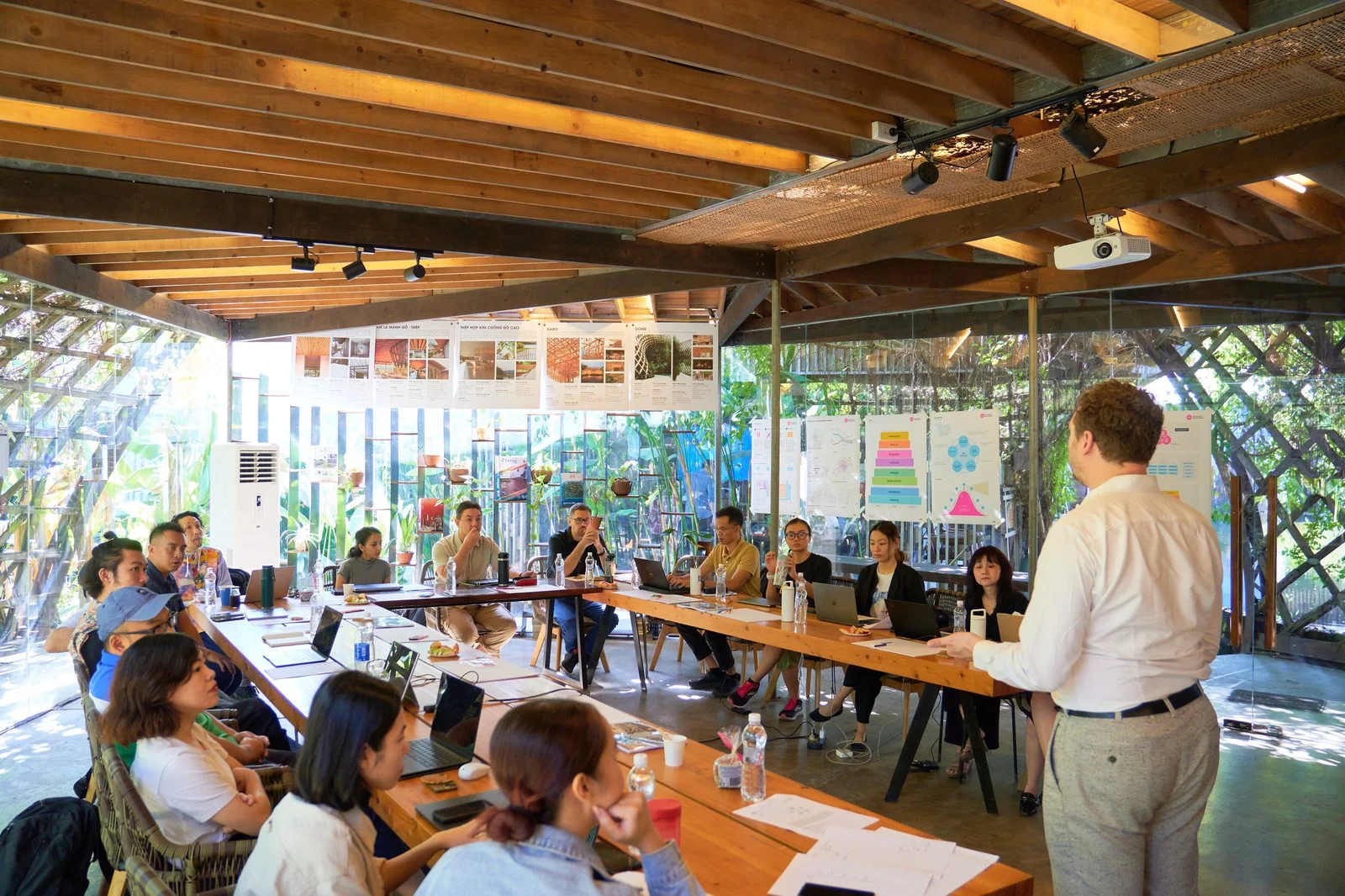
The project opened with a leadership training program. Senior managers from across the organization, operations, procurement, farm management, restaurant design, human resources, participated in sessions that introduced the Symbiosis in Development (SiD) framework. The purpose was not to teach sustainability as a separate discipline but to build a shared language for seeing how the company's activities connect to each other and to the larger systems they depend on.
This step matters more than it appears. In most organizations, sustainability knowledge lives in a specialized team that translates environmental and social data into reports. The rest of the organization treats sustainability as a constraint or a cost center. SiD training reverses that dynamic. It equips operational leaders to recognize sustainability dimensions in their own decisions: how a menu change affects farm planning, how restaurant energy design influences supply chain emissions, how staff development programs shape community outcomes.
By the time the co-creation workshop convened in Ho Chi Minh City, every participant understood the framework well enough to contribute as a systems thinker, not just a domain expert.
The co-creation workshop
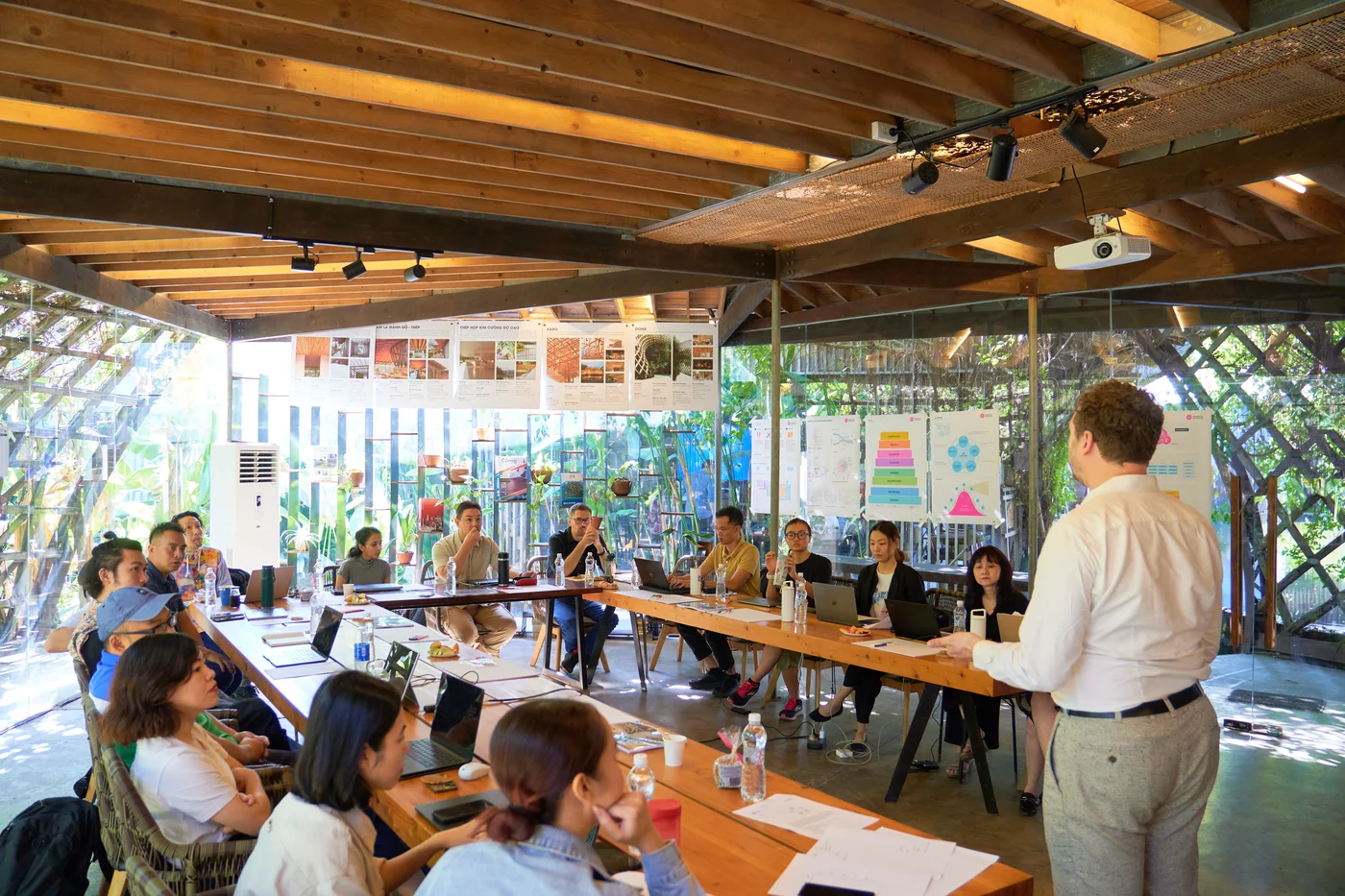
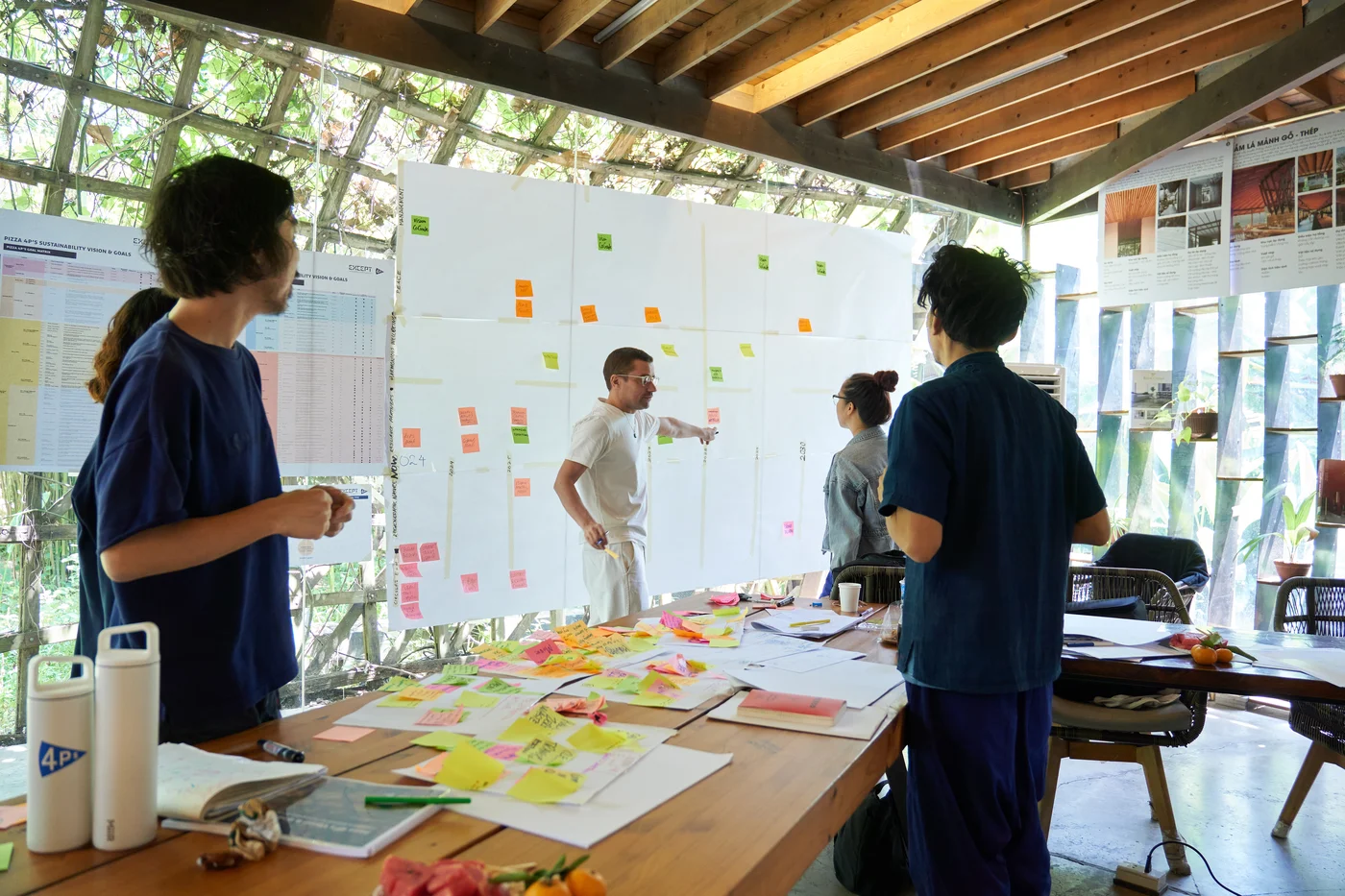
The multi-day workshop brought together Pizza 4P's leadership with Except's strategy team. The first task was to map the company's full system: material flows from farm to table, energy inputs at every stage, water cycles in dairy production and kitchen operations, waste outputs and their current destinations, biodiversity interactions at farm sites, and the web of community relationships that the company had built across Vietnam.
System mapping at this resolution reveals patterns that siloed analysis misses. The workshop surfaced several. Water used in cheese production could be recovered and directed to farm irrigation, closing a loop that reduced both water consumption and treatment costs. Organic waste from kitchens, if processed through composting or biodigestion, could return nutrients to the farms that supplied the restaurants. Energy investments in solar installations at production facilities could offset consumption at multiple downstream points.
These are not hypothetical synergies. They are structural relationships that exist in the system whether or not anyone acts on them. The workshop made them visible. More importantly, it revealed which relationships carried the most leverage: where a single investment or policy change would produce cascading benefits across multiple domains.
The team also mapped stakeholder relationships. Pizza 4P's operates in a web of connections: farmers, suppliers, local communities, municipal governments, staff across dozens of locations, and a growing customer base that increasingly asks about the provenance and impact of what they eat. Each of these relationships carries both dependencies and opportunities. A strategy that ignores them produces plans that look elegant on paper and stall on implementation.
A 15-year roadmap across five domains
The workshop's output was a 15-year sustainability roadmap organized across five interconnected domains: energy, water, biodiversity, food systems, and community. Each domain contains a sequenced set of interventions, with dependencies mapped between them and clear decision points where progress in one domain unlocks action in another.
The energy domain charts a path from current grid dependence through efficiency improvements, on-site solar generation, and eventually energy-positive operations at key facilities. The water domain addresses the full cycle: sourcing, use in production and kitchens, treatment, and recovery. The biodiversity domain connects farm management practices to ecological outcomes, tracking how sourcing decisions affect habitat, soil health, and pollinator populations around Pizza 4P's agricultural operations.
The food systems domain is where the company's "Farm to Table" philosophy meets systemic rigor. The roadmap traces every significant ingredient from source to plate, identifies where supply chain improvements produce the largest reductions in environmental impact, and sequences changes so that supplier capacity keeps pace with the company's ambitions. Moving to regenerative agriculture practices at partner farms, for example, requires soil transition periods that need to start years before the company can claim regenerative sourcing across its menu.
The community domain addresses what most corporate sustainability strategies leave as an afterthought: the social fabric that surrounds and sustains the business. Pizza 4P's restaurants are gathering places. Staff are community members. Sourcing decisions shape local economies. The roadmap treats these relationships as strategic assets to be cultivated, not externalities to be managed.
Why 15 years changes the logic
Most sustainability strategies operate on three- to five-year horizons. That is long enough to set targets, short enough to hold executives accountable, and almost always too short to change the systems that produce the problems. A three-year energy plan optimizes existing infrastructure. A 15-year energy plan redesigns the energy system.
The difference is not ambition. It is strategic freedom. A longer horizon allows the roadmap to include interventions that take years to mature: soil regeneration, ecosystem restoration, community capacity building, infrastructure investments whose returns compound over decades. It also permits honest sequencing. Some changes cannot start until other changes are in place. A three-year window forces organizations to pursue everything in parallel, overwhelming implementation capacity. A 15-year window lets them build foundations first.
For Pizza 4P's, the long horizon also reflects the nature of the business. Restaurants are deeply embedded in their communities and supply landscapes. A farm relationship that takes five years to develop and ten years to mature produces ingredients, knowledge, and resilience that no short-term sourcing contract can match. The roadmap accounts for this by treating early investments in supplier development and community engagement as strategic infrastructure, not as costs that need to be justified against quarterly returns.
The engagement demonstrates a pattern that applies well beyond food and hospitality. When a company's operations touch natural systems (energy, water, soil, biodiversity) and social systems (communities, supply chain partners, staff), the interactions between these systems determine the long-term viability of the business. A strategy that maps those interactions, identifies the leverage points, and sequences interventions across a realistic time horizon produces something qualitatively different from a target list. It produces a capacity for continuous adaptation, a company that learns its way into sustainability rather than lurching from initiative to initiative.
Pizza 4P's entered the engagement with a clear ambition and a genuine track record of innovation. What it gained was a structure for turning that ambition into a coherent, sequenced, system-aware strategy that its teams can execute, adapt, and extend over the next decade and a half.
More case studies
Designing a regenerative neighborhood from first principles
Carpet Sector: Circular Roadmap
Ready to map your system?
Every case begins with a conversation about the system you operate in and the leverage points within it.
Book an introduction