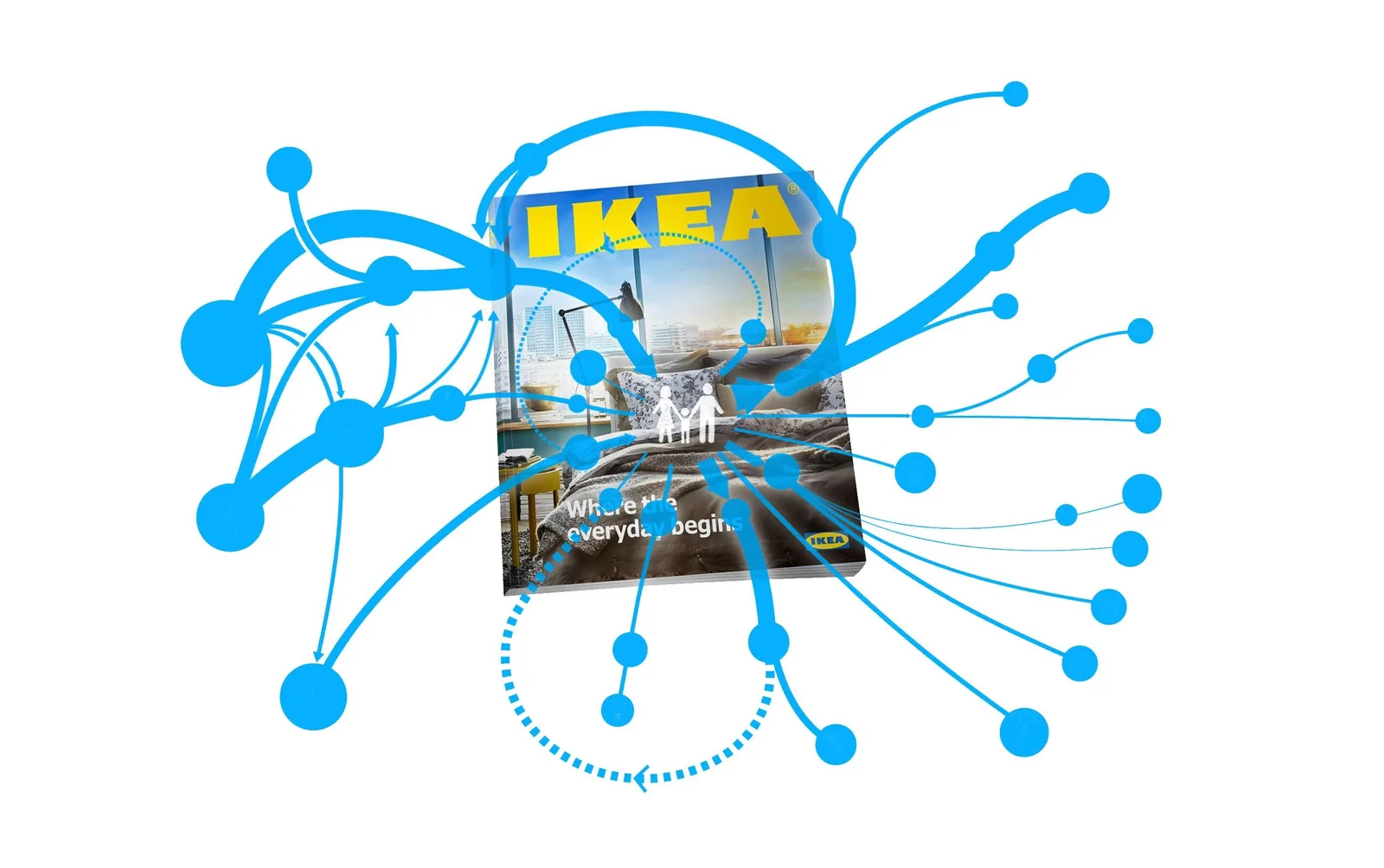
How IKEA learned to see its supply chain
A global paper supply chain is not a procurement problem. It is a learning problem. What the IKEA engagement reveals about the difference between optimizing a system and understanding one.
Inter-IKEA’s print supply chain is, by any measure, one of the largest in the world. The catalogues, packaging, and in-store materials that the group produces every year involve forestry operations, pulp mills, paper manufacturers, printers, and logistics networks across dozens of countries. Each link in that chain has its own suppliers, its own environmental footprint, its own labor practices, and its own exposure to regulatory and market risk. Mapping it in any rigorous way was not a standard procurement analysis. It was a systems problem.
When Except Integrated Sustainability began working with Inter-IKEA’s supply chain team, the initial framing was conventional: identify the main environmental impacts, prioritize them, develop reduction targets. This is the template that most large organizations apply to supply chain sustainability, and it produces a certain kind of result: a ranked list of hotspots, a set of percentage reductions to pursue, and a reporting framework that can demonstrate year-on-year progress.
What it does not produce is a working model of how the supply chain actually functions as a system, why it produces the outcomes it produces, and where intervention would have the greatest effect. That requires a different starting point.
The learning problem
The most important thing Inter-IKEA’s supply chain team needed was not data. They had substantial data already. What they needed was a way to understand what the data was telling them about the underlying system, to distinguish between the symptoms of a problem and its causes, and to identify where their leverage actually was.
This is what we mean by calling it a learning problem. The system that produces a global print supply chain is made up of actors with different incentives, operating on different time horizons, with different information, in different regulatory environments. The behavior of that system cannot be read directly from the data it generates. It has to be inferred from the patterns in that data, tested against knowledge of how the components interact, and revised as new evidence emerges.
The SiD framework begins with the system’s context: what are the ecological and social conditions that this supply chain depends on, and what is the current state of those conditions? For a paper supply chain, this means forest cover, water availability, soil health, and community livelihoods in the regions where fiber is sourced. It means the regulatory trajectory in those regions, the certification standards that are operative, and the gaps between certified practice and observed ecological outcomes. These are not stable parameters. They change, and the rate and direction of that change determines how much risk is embedded in the current supply chain design.

Working with this team fundamentally changed how we see our supply chain. We stopped asking ‘how do we reduce our footprint’ and started asking ‘how does this system actually work?’Matthieu Leroy, Inter-IKEA

What the analysis revealed
When the supply chain was mapped as a system rather than as a set of procurement relationships, several structural features became visible that had not been apparent from the conventional sustainability analysis. The concentration of sourcing in regions with rapidly changing forest governance created systemic risk that was not captured in the existing hotspot ranking. The time delays between forest management decisions and their ecological consequences meant that current certification status was not a reliable indicator of future fiber availability. And the incentive structures facing mid-chain actors, the pulp mills and paper manufacturers, created a selection effect that was systematically distorting the reported sustainability performance of the chain.
None of this was unintelligible from within the data that Inter-IKEA already had. But it required a different analytical frame to become visible: one that asked about the causal structure of the system rather than simply describing its current state.
The practical consequence was a reorientation of where the supply chain team invested its attention. Rather than continuing to work primarily on the environmental metrics at each node of the chain, they began working on the feedback loops that connected those nodes, the information flows that allowed learning to happen across the system, and the governance structures that could make that learning durable.
The difference between optimization and understanding
Optimization and understanding are not the same activity. Optimization takes the structure of a system as given and finds the most efficient operating point within it. Understanding examines the structure itself, asks why it is the way it is, and identifies whether the structure is well-suited to the goals being pursued.
Most supply chain sustainability work is optimization. It takes the existing supplier relationships, the existing certification frameworks, and the existing measurement protocols as the structure within which improvement must occur. This produces real results, incrementally. But it cannot address systemic risks that are built into the structure, and it cannot identify the structural changes that would produce qualitatively different outcomes.
What Inter-IKEA’s engagement produced was not primarily a set of optimized metrics. It was a working model of the supply chain as a learning system: one with explicit feedback loops, identified leverage points, and governance mechanisms that allowed the team to continue improving their understanding of the system rather than simply managing their performance within it.
The distinction matters because the environment that supply chains operate in is not stable. Regulatory requirements change. Forest governance evolves. Material prices shift. Climate effects propagate through agricultural and forestry systems in ways that are difficult to predict precisely. A supply chain that is optimized for current conditions but does not understand how it functions as a system will be repeatedly surprised by these changes. A supply chain that has developed genuine understanding of its own dynamics can anticipate them, adapt to them, and in some cases influence the conditions that produce them.
That is the difference between a procurement strategy and a systems strategy. And it is why the most durable supply chain improvements tend to come not from better data collection, though that matters, but from better models of what the data is telling you about the system you are inside.