
Building sustainability capacity in Vietnam's packaging industry
Vietnam's packaging industry faces mounting regulatory and market pressure to demonstrate sustainability performance. Starprint chose to lead rather than follow.
Key result
12-person sustainability team trained, 360-degree sustainability plan established with measurable goals
Vietnam produces enormous volumes of packaging for global consumer brands. Plastics constitute 94 percent of waste items and 71 percent by weight of all waste in the country, according to World Bank data from 2022. The government aims to eliminate single-use plastics in key sectors by 2030. European and North American clients are tightening sustainability requirements in their procurement contracts. For Vietnamese manufacturers, the question is no longer whether to transition. It is whether they will lead the transition or be forced into it on someone else's terms.
Starprint Vietnam, a packaging manufacturer operating since 2001 with roots in Thailand dating to 1962, chose to lead. The company serves global clients across food, toy, hygiene, and cosmetics markets. Its leadership recognized that sustainability performance was becoming a market differentiator, not a cost center. But the gap between that recognition and a credible, executable strategy was wide. Bridging it required building internal capacity that did not yet exist.
Building a team before building a plan
Most sustainability programs begin with a strategy document. This one began with people. The first phase of the year-long engagement focused on assembling and training a 12-person core team drawn from across Starprint's operations: production, procurement, quality, logistics, sales, and management. These were not sustainability specialists. They were operational leaders who understood how the business actually worked.
The training covered sustainability fundamentals, industry standards, global regulatory trends, and the Symbiosis in Development (SiD) framework. The goal was not to turn engineers into environmental scientists. It was to give operational decision-makers the vocabulary, the analytical tools, and the systems perspective needed to identify sustainability opportunities within their own domains of responsibility.
This sequencing was deliberate. A strategy written by external consultants and handed to an unprepared organization produces a document that sits on a shelf. A strategy developed by a trained internal team produces a plan that the organization knows how to execute, because the people who built it are the same people who will implement it.
Data before decisions
In parallel with the training, the core team gathered and structured data on Starprint's environmental footprint: energy consumption by process, material inputs and waste outputs, water use, emissions profiles, and logistics patterns. For many of these categories, the data had never been aggregated or analyzed in an integrated way.
Except supplemented this internal data with external intelligence: a comparative analysis of competitor sustainability performance, a scan of upcoming legislative changes in Vietnam, the EU, and key export markets, and a review of best practices in sustainable packaging from manufacturers globally. This external context was critical because Starprint's sustainability strategy needed to anticipate where markets and regulations were heading, not respond to where they were.

Co-creation in Ho Chi Minh City
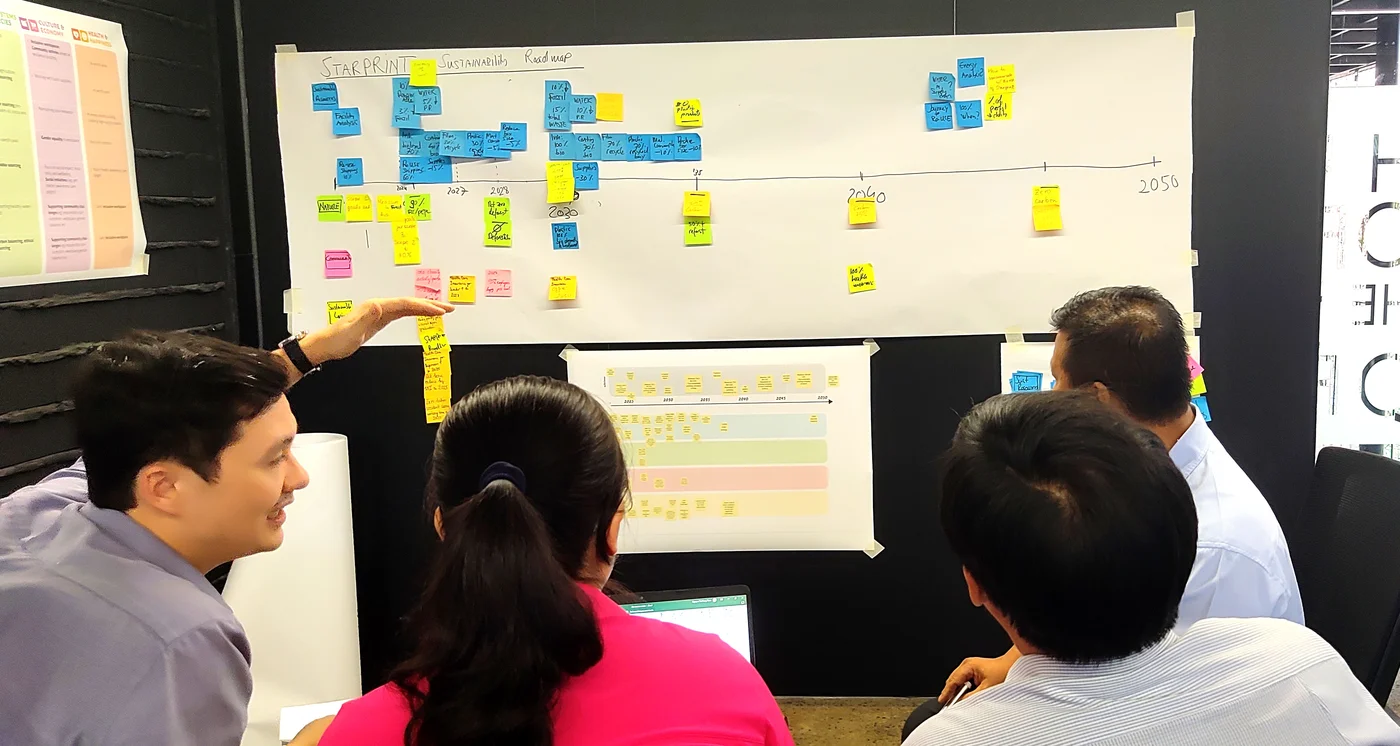
The data phase culminated in a two-day co-creation workshop in Ho Chi Minh City. The trained core team, now equipped with both sustainability knowledge and operational data, worked through the SiD process to develop Starprint's sustainability vision, identify priority focus areas, establish measurable goals, and lay out a baseline roadmap structure.
The workshop used SiD's system mapping tools to visualize Starprint's operations as a set of interconnected material, energy, information, and value flows. This visualization revealed leverage points that were not visible from within any single department's perspective. A change in material sourcing, for example, had cascading effects on waste management, energy use, and client compliance requirements. Mapping these connections allowed the team to prioritize interventions that addressed multiple goals simultaneously.
The resulting roadmap provides a 360-degree structure connecting all aspects of the business in a single integrated view. It functions as a management cockpit: C-suite executives and key managers can see how sustainability initiatives connect to operational performance, where progress is on track, and where attention is needed. This operational integration is what transforms sustainability from a reporting exercise into a strategic capability.
Systemic strategy in emerging markets
The Starprint engagement demonstrates how systemic strategy applies in emerging market manufacturing. The challenges are different from those in established European or North American companies. Data infrastructure is often underdeveloped. Internal sustainability expertise is scarce. Regulatory frameworks are evolving rapidly. Client requirements vary by export market.
These constraints make systemic thinking more important, not less. When resources are limited, the cost of misallocating them is higher. Identifying the leverage points where investment produces the greatest return, in both sustainability performance and market position, is precisely what systemic analysis provides. Starprint's roadmap prioritizes the interventions that strengthen the company's competitive position while building the foundation for longer-term transformation.
The engagement continues. Starprint is now implementing the roadmap, rolling out new products and processes aligned with the sustainability vision its own team developed. The capacity built during the training phase means the organization can adapt the roadmap as conditions change, without depending on external consultants for every decision.
That independence is the real deliverable. Consulting engagements that create permanent dependency on the consultant have failed, regardless of what the strategy document says. The Starprint model invests upfront in building the organization's own capability to think systemically, gather and analyze data, and adjust strategy as conditions evolve. The consultant leaves. The capability remains. For a company navigating a decade of regulatory and market transformation, that capability is worth more than any static plan.
More case studies
Pizza 4P's: 15-year strategy

Global Disruption and Trends Report: Vietnam 2045
Regenerative agriculture at national scale in Egypt
Ready to map your system?
Every case begins with a conversation about the system you operate in and the leverage points within it.
Book an introduction