
The governance of transitions
Most transition plans describe destinations. Few specify who makes which decisions, at which thresholds, and with which authority. Governance is where transitions succeed or stall.
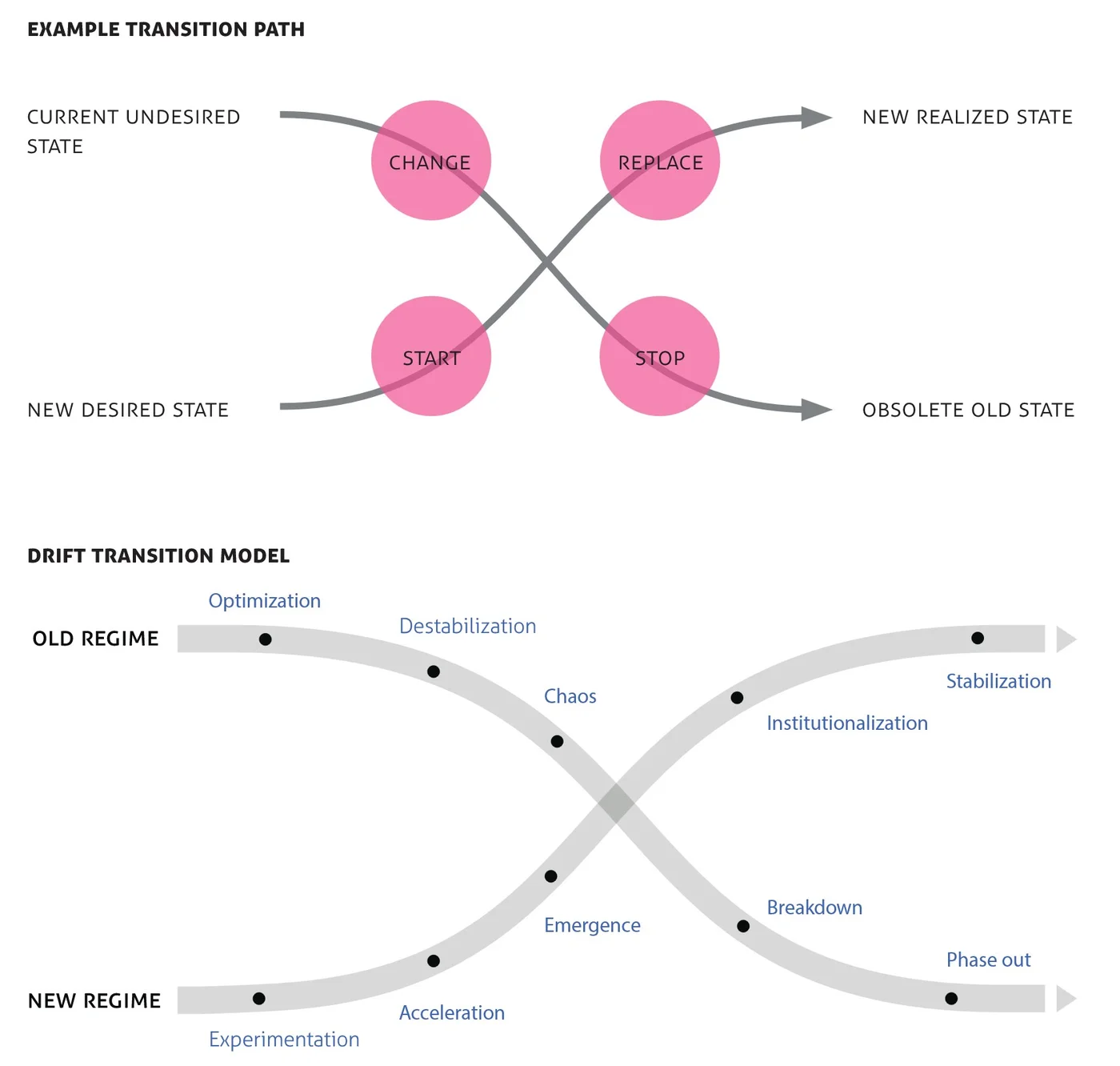
The word “transition” implies movement from one state to another. What it does not imply, but should, is the governance apparatus required to manage that movement: the decision authorities, the information flows, the escalation paths, and the adaptation mechanisms that allow an organization to navigate a transition without losing coherence.
Most transition roadmaps are weak on governance. They specify what will change and when, but not who decides when a threshold has been crossed, who has authority to reallocate resources when the plan encounters resistance, or what the criteria are for determining that the underlying strategy needs revision rather than simply better execution. These omissions are not oversights. They reflect a genuine difficulty: governance for transitions is different from governance for stable operations, and most organizational governance frameworks were designed for the latter.
Why operational governance fails in transitions
In a stable operating environment, governance is largely about ensuring that the right decisions are made at the right level of the organization, with the right information, within agreed parameters. The parameters are relatively fixed, the decision types are familiar, and the escalation criteria are understood. This kind of governance is well suited to optimizing a known operation.
Transitions are different. They involve moving through territory that the organization has not previously traversed, making decisions that may not fit the existing parameters, and encountering conditions that were not anticipated in the original plan. Operational governance, applied to a transition, tends to produce one of two failure modes: either it is too rigid, rejecting necessary adaptations because they fall outside approved parameters, or it is too loose, delegating decisions that require strategic authority to operational levels that cannot see the whole picture.
Effective transition governance requires a third mode: structured adaptability. The governance framework specifies, in advance, which types of decisions can be made at which levels, what information is needed to make them, and what triggers escalation to a higher authority. It also specifies how learning from the transition gets incorporated into the plan, and under what conditions the plan itself should be fundamentally revised rather than incrementally adjusted.
We cannot predict what we will discover, but we can design systems that help us discover and respond. The capacity to learn from a transition is itself a strategic asset.Fritjof Capra, physicist and systems thinker

The trigger table as governance instrument
One of the most practical tools for transition governance is the trigger table: a pre-committed specification of conditions that, when met, require specific decisions or actions. A trigger table removes the ambiguity that typically surrounds adaptation decisions in transitions. Instead of debating whether the evidence is sufficient to warrant a change in course, the organization has agreed in advance what the decision criteria are and who has authority to act on them.
Trigger tables work at multiple scales. At the portfolio level, they specify when a program should be accelerated, paused, or discontinued based on defined performance indicators. At the strategy level, they specify when the underlying assumptions of the strategy should be reviewed and what evidence would constitute grounds for fundamental revision. At the governance level, they specify when board-level engagement is required rather than delegated to management.
The pre-commitment aspect is important. Organizations that build trigger tables in advance of encountering the conditions they describe tend to act more decisively when those conditions arise, because the decision has already been made in principle. Organizations that try to make the same decision in the middle of a difficult transition, without pre-commitment, tend to delay, debate, and defer in ways that compound the underlying problem.
Multi-stakeholder governance
Many of the transitions that organizations face cannot be governed by any single actor, because the systems they involve extend across organizational and regulatory boundaries. A packaging transition that requires changes to collection infrastructure, material standards, and consumer behavior cannot be governed by the company producing the packaging alone. It requires coordinated governance across the value chain, potentially including regulators, municipalities, and competing producers.
This is not a reason to avoid systemic ambition. It is a reason to design the governance architecture for the transition as carefully as the operational roadmap. Multi-stakeholder governance for transitions has a set of structural requirements that are not met by standard industry association models: clear decision-making authority for transition-specific choices, information sharing protocols that allow the governance body to understand how the transition is progressing, mechanisms for resolving conflicts between actors with different incentives, and a legitimate process for revising the shared roadmap as circumstances change.
Organizations that recognize this early and invest in building the governance architecture for the transition, not just the technical roadmap, tend to move faster and encounter fewer coordination failures than those that treat governance as a detail to be worked out later. Governance is where transitions succeed or stall, and the time to build it is before you need it.