Carpet Sector: Circular Roadmap
Sector-wide circular economy roadmap for the Dutch carpet industry with MODINT and DNV. System mapping of material flows, recycling and bio-based pathways through 2030.
Key result
Sector-wide circular transition roadmap through 2030
The Netherlands produces roughly 40 million square meters of carpet each year. Most of it ends up in landfills or incinerators at end of life. The materials locked inside those carpets, nylon, polypropylene, polyester, calcium carbonate, latex, represent both a waste problem and an economic opportunity. Extracting and reusing them could reduce virgin material demand, lower carbon emissions, and create new revenue streams for an industry under pressure from hard flooring alternatives and rising raw material costs.
But carpet recycling at scale is not a sorting problem. It is a systems problem. The carpet industry involves raw material suppliers, yarn producers, backing manufacturers, tufting companies, distributors, installers, building owners, demolition contractors, and waste processors. Each operates on different incentives, timelines, and regulatory frameworks. A circular economy for carpet requires all of them to change what they do, in a coordinated sequence, based on shared information about material flows that currently no one tracks end to end.
MODINT, the Dutch fashion and textile trade association, and DNV, the global certification and risk management firm, commissioned Except to create that coordination instrument: a sector-wide circular economy roadmap for the Dutch carpet industry, with a target horizon of 2030.
Mapping the status quo
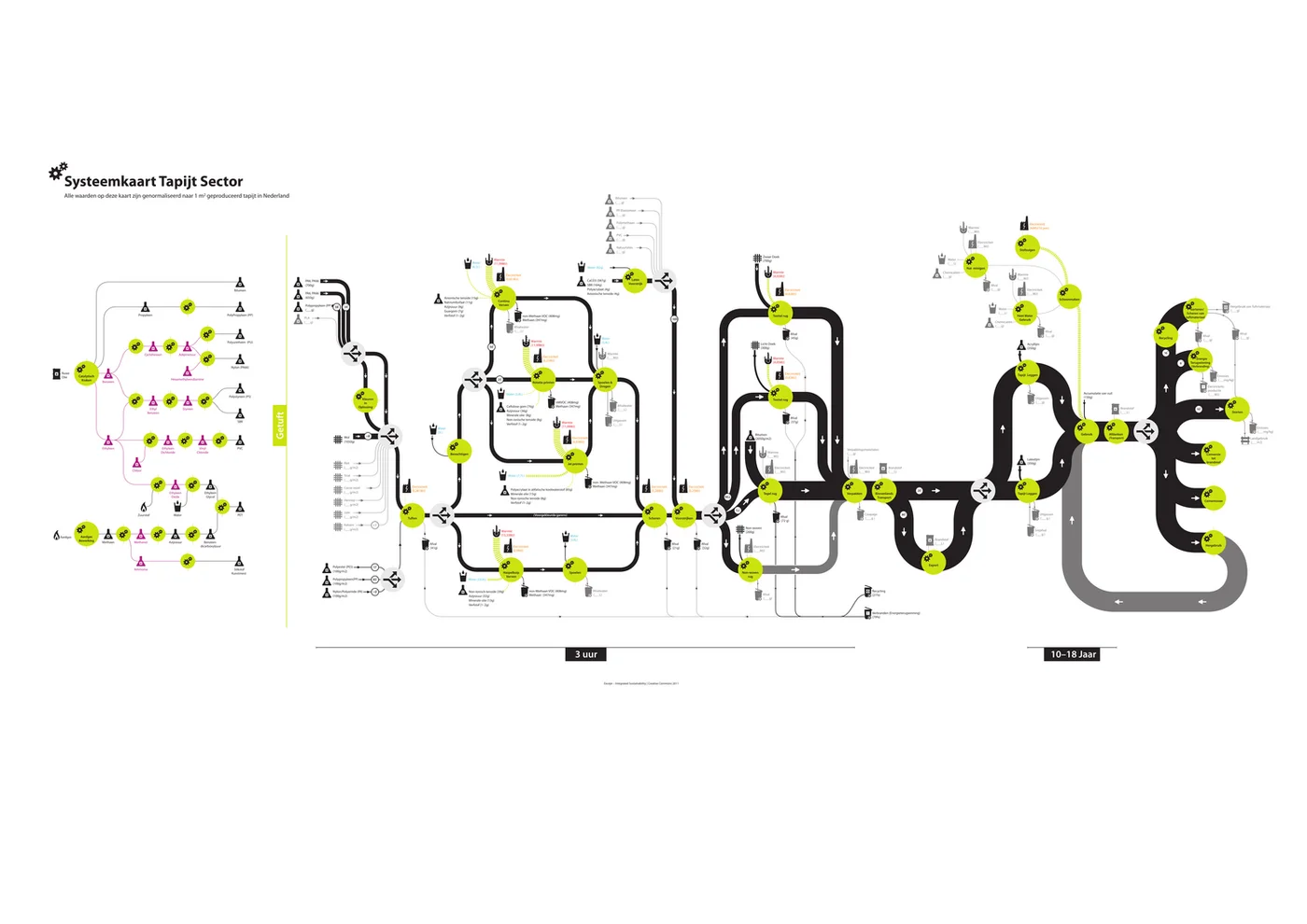
The first phase of the project produced something the industry had never had: a complete system map of how materials move through the Dutch carpet sector. The map traces every significant material flow from raw material extraction through manufacturing, distribution, use, and end-of-life processing. It identifies where materials accumulate, where they leak out of the system, where energy is consumed, and where information gaps prevent better decisions.
Building this map required data from across the value chain. Yarn producers contributed material composition data. Manufacturers shared production volumes and waste rates. Waste processors provided end-of-life recovery statistics. Building owners and facility managers supplied usage duration and replacement cycle data. The result was a quantified model of the sector's metabolism: how much of each material enters the system annually, what fraction gets recovered, and where the rest goes.
The status quo map revealed several structural problems that individual companies could not see from their own positions. The most significant: there was no functioning feedback loop between end-of-life processing and manufacturing. Carpet manufacturers designed products without knowing what happened to them after removal. Waste processors received carpets without knowing their material composition. The result was that technically recyclable materials were being landfilled or incinerated because no one had the information needed to recover them efficiently.

Designing the 2030 vision
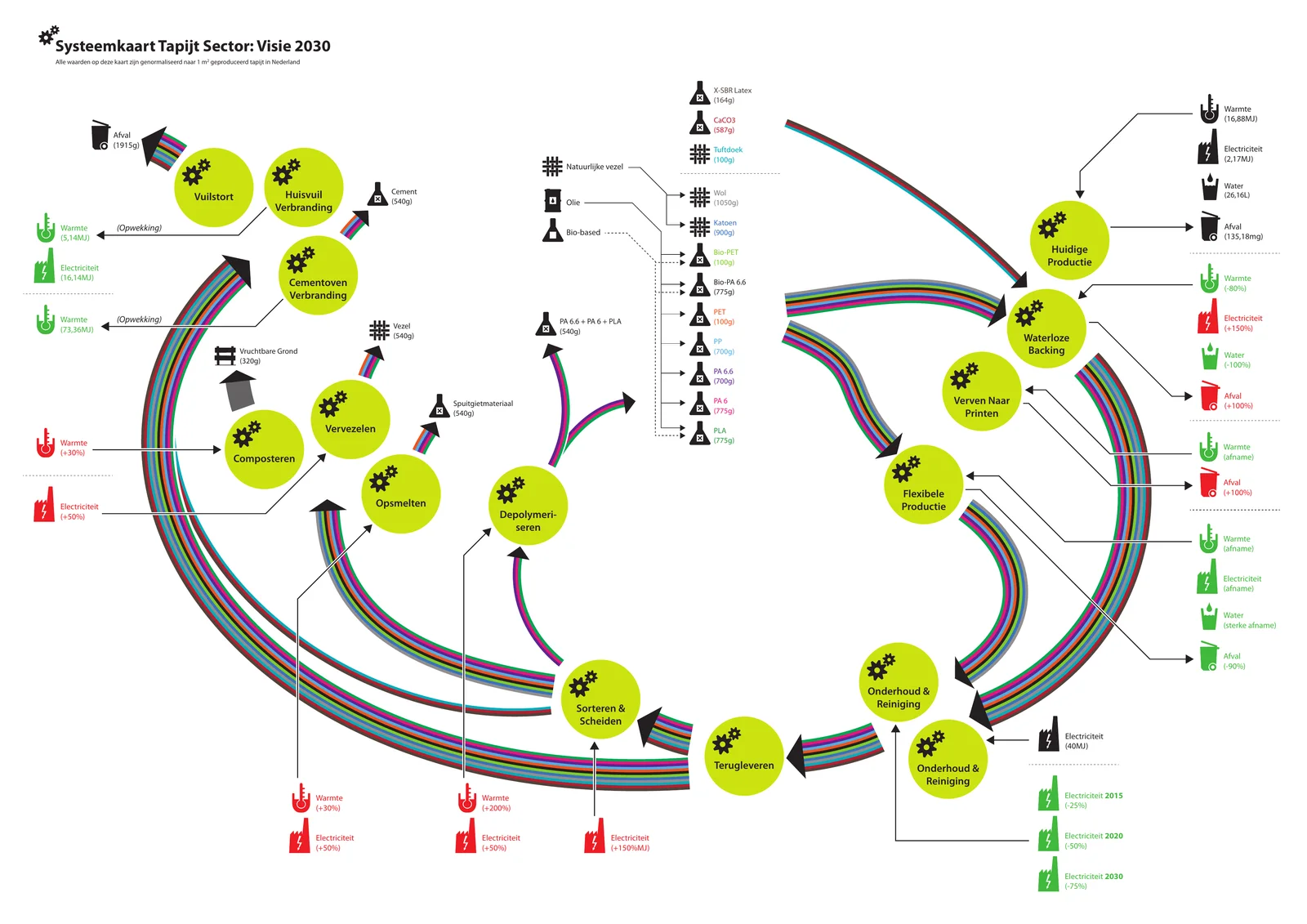
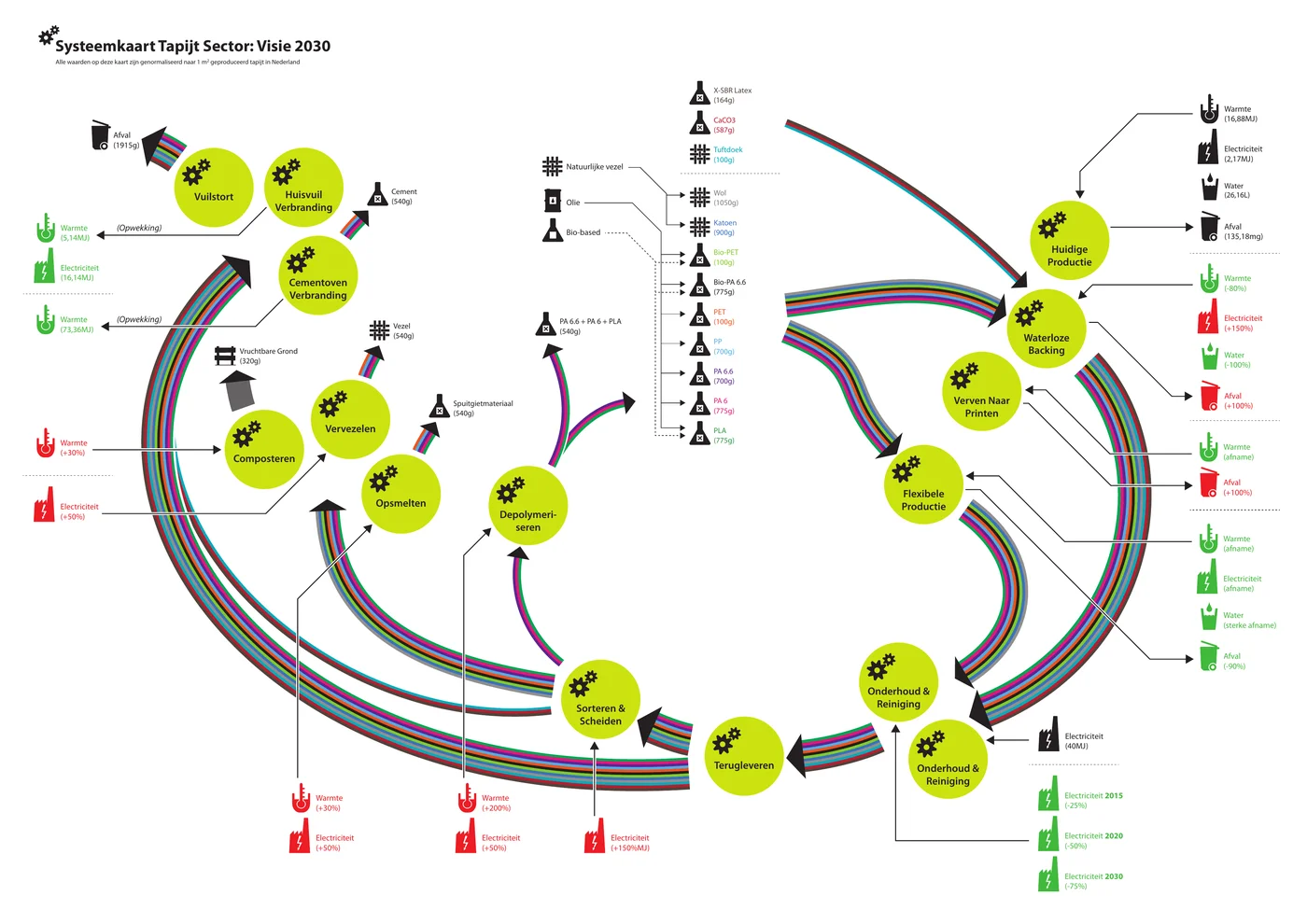
The second system map shows what the sector could look like by 2030 if the identified interventions succeed. The contrast with the status quo is structural, not incremental. In the 2030 vision, material flows form closed loops. Post-consumer carpet feeds back into manufacturing as a raw material source. Bio-based alternatives replace petrochemical inputs where technically feasible. Design standards ensure that new carpets are manufactured for disassembly, with material compositions documented in digital product passports that follow the carpet through its entire lifecycle.
The vision map is not aspirational illustration. It is an engineering document. Each loop in the diagram corresponds to a specific technical pathway: mechanical recycling of nylon face fibers, chemical recycling of mixed polymer waste, recovery and reuse of calcium carbonate fillers, energy recovery from fractions that cannot yet be materially recycled. Each pathway has identified technology readiness levels, capacity requirements, and economic conditions that need to be met.
Three recycling pathways emerged as priorities. Mechanical recycling of nylon 6 face fibers, which can be depolymerized back to caprolactam and repolymerized into virgin-quality nylon. Chemical recycling processes for mixed polymer fractions that mechanical separation cannot handle. And bio-based material substitution, replacing petroleum-derived backing and fiber materials with plant-based alternatives that maintain performance characteristics while reducing the sector's fossil fuel dependence.
From maps to roadmap
A system map shows where you are and where you want to go. A roadmap shows the sequence of steps that gets you there, who needs to take each step, and what conditions must be met before each step becomes feasible.
The sector roadmap organized interventions into three time horizons. Near-term actions (one to three years) focused on information infrastructure: establishing material composition databases, creating collection and sorting protocols, and launching pilot recycling partnerships between manufacturers and waste processors. These are prerequisites. Without them, later interventions cannot function.
Medium-term actions (three to seven years) addressed the physical infrastructure: scaling recycling capacity, establishing reverse logistics networks, and redesigning products for recyclability. These require capital investment that only makes sense once the information infrastructure is in place and material volumes are predictable.
Long-term actions (seven to twelve years) targeted systemic shifts: moving the sector toward bio-based materials, establishing closed-loop supply agreements, and embedding circular design principles into industry standards and building specifications. These depend on the learning that accumulates through near- and medium-term interventions.
The roadmap also identified governance requirements. A sector-wide transition cannot be driven by any single company. It requires coordination mechanisms: shared data platforms, industry agreements on material standards, and policy engagement to align regulatory incentives with circular outcomes. The project specified what each of these mechanisms needed to look like and which organizations were best positioned to host them.
Why sector-level strategy differs from company strategy
Most circular economy work operates at the company level. A manufacturer redesigns its products. A retailer launches a take-back program. A waste processor invests in new technology. Each of these efforts is valuable, but none of them can close the loop alone. The carpet industry's material flows cross organizational boundaries dozens of times between raw material and end of life. A circular economy requires coordination across all of those boundaries.
Operating at sector level changes the analysis in fundamental ways. A company sees its own waste as a cost. A sector map reveals that same waste as a feedstock for another company's production process. A company sees recycling technology as a capital expense with uncertain returns. A sector roadmap shows the minimum throughput volume needed to make that technology economically viable, and identifies which combination of companies can collectively provide that volume.
The Dutch carpet sector project demonstrates that the transition to a circular economy is fundamentally a coordination problem. The technologies exist or are within reach. The economic case is sound at sufficient scale. What has been missing is the shared map, the agreed sequence, and the governance structure to coordinate action across an entire value chain. MODINT, DNV, and Except produced those instruments. The sector now has a common picture of where it is, where it needs to go, and the order in which things need to happen to get there.
The pattern transfers directly to other material-intensive sectors facing similar challenges: textiles, construction materials, packaging, electronics. In each case, the bottleneck is not technology or economics. It is the absence of a system-level view that lets actors coordinate their individual transitions into a coherent whole.
More case studies



Ready to map your system?
Every case begins with a conversation about the system you operate in and the leverage points within it.
Book an introduction